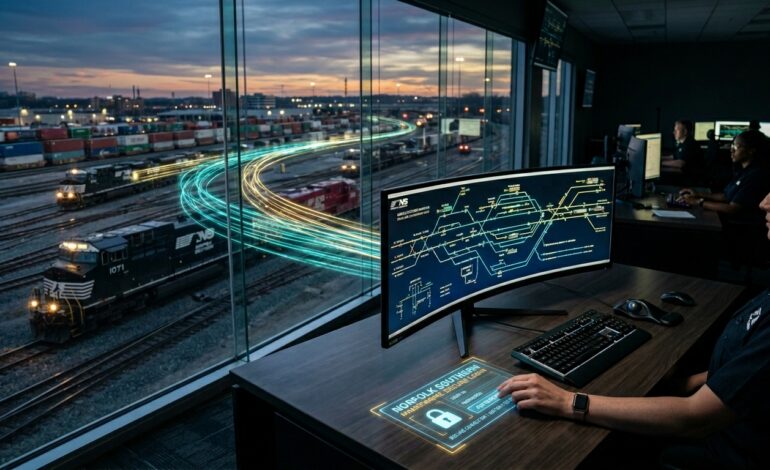
The Norfolk Southern Mainframe: Powering the Digital Arteries of Modern Rail Logistics

In the world of heavy transportation and transcontinental logistics, the physical spectacle of a locomotive often overshadows the digital complexity required to keep it moving. Central to the operations of one of North America’s premier transportation companies is the norfolk southern mainframe. This high-performance computing environment serves as the central nervous system for the organization, processing millions of transactions daily to ensure that freight moves safely, crews are deployed efficiently, and the supply chain remains unbroken.
While modern cloud computing often dominates headlines, the reliability and massive throughput of the norfolk southern mainframe remain indispensable for real-time mission-critical tasks. In this comprehensive guide, we will analyze the technical architecture, operational necessity, and security protocols of this “hidden tech backbone,” providing a detailed look at how high-volume computing sustains the rail industry.
1. The Architecture of Reliability: Why Mainframes Still Rule the Rails
The reliance on a norfolk southern mainframe is not a matter of legacy inertia, but rather a strategic choice based on the unique demands of the railroad industry. Railroads operate 24/7, across vast geographical distances, requiring a level of “five-nines” availability (99.999%) that few distributed systems can match.
The mainframe norfolk southern utilizes is designed for massive I/O (Input/Output) capabilities. When you consider the sheer volume of data—ranging from GPS coordinates of thousands of railcars to the complex duty-status logs of thousands of employees—the need for a centralized, highly secure processing unit becomes clear. These systems are optimized for batch processing and transactional integrity. In simpler terms, when a car is scanned at a terminal, that data must be updated across the entire network instantly without the risk of record loss or corruption.
Furthermore, the norfolk southern mainframe environment is built on a foundation of extreme vertical scalability. Unlike cloud clusters that scale “out” by adding more servers, a mainframe scales “up,” allowing it to handle sudden spikes in data—such as during peak holiday shipping seasons or extreme weather rerouting—without the latency issues often associated with distributed networks.
2. Operational Core: Crew Scheduling and Logistics Management
One of the most vital functions of the norfolk southern mainframe is the management of human capital and equipment. The railroad is governed by strict federal regulations regarding crew rest and operating hours. Managing this for thousands of workers requires a sophisticated logic engine that only a robust mainframe can provide.
Crew Management and the Norfolk Southern Mainframe Login
Authorized personnel and crew members interact with this system via the norfolk southern mainframe login portal. This interface allows for real-time reporting and scheduling. By centralizing this data, the company ensures that every locomotive is staffed by a crew that is fully rested and compliant with Safety Act requirements.
Freight Tracking and Waybill Processing
Every shipment on the rail network starts with a waybill—a legal document outlining the details of the freight, its origin, and its destination. The norfolk southern mainframe processes these digital documents, linking them to specific railcars and trains. This allows for:
Precision Scheduling: Knowing exactly when a train will arrive at a siding or a port.
Asset Utilization: Reducing “dwell time” (the time a car sits idle) by ensuring that the next locomotive is ready to pick it up.
Intermodal Coordination: Seamlessly transitioning freight from rail to truck or ship.
For those interested in how these logistics systems integrate with broader supply chain management, you may find our deep dive into enterprise resource planning helpful.
3. Safety Protocols and Real-Time Monitoring Systems
Safety is the paramount priority in rail operations, and the norfolk southern mainframe plays a lead role in disaster prevention and risk mitigation. Modern rail networks are equipped with a variety of sensors, including hot-box detectors (which sense overheating wheel bearings) and Positive Train Control (PTC) systems.
The norfolk southern mainframe acts as the aggregator for this sensor data. When a sensor on the track detects an anomaly, the information is relayed back to the mainframe environment, where it is analyzed against historical data and safety thresholds. If a threat is detected, the system can assist dispatchers in making split-second decisions to halt or slow trains, potentially preventing derailments.
This level of monitoring requires a system that can handle “data gravity”—the idea that data should be processed as close to its source or in a central hub that can handle the massive influx without bottlenecking. By maintaining a centralized mainframe norfolk southern can ensure that safety-critical information is never “stuck” in a slow cloud synchronization loop.
4. Security and Access: Protecting the Backbone
Given the importance of rail to national infrastructure, the security of the norfolk southern mainframe is a matter of national security. The systems are shielded by multiple layers of encryption and rigorous access controls.
The Security of the Norfolk Southern Mainframe Login
Accessing the internal systems requires more than just a simple password. The norfolk southern mainframe login utilizes Multi-Factor Authentication (MFA) and encrypted tunnels (VPNs) to ensure that only verified employees and contractors can enter the system. This prevents unauthorized users from interfering with train movements or sensitive logistics data.
Cybersecurity Resilience
Mainframes are inherently more secure than traditional PCs or servers because of their unique operating systems (such as z/OS). These systems are less vulnerable to common malware and ransomware that target more widely used platforms. Additionally, Norfolk Southern employs a dedicated team of cybersecurity experts who monitor the mainframe environment 24/7 for any signs of intrusion or anomalous behavior.
For further reading on protecting critical infrastructure, check out our guide to cybersecurity best practices.
5. The Future of Rail Tech: Modernizing the Mainframe
There is a common misconception that mainframes are “old tech.” In reality, the norfolk southern mainframe is constantly evolving. The modern approach is a “hybrid cloud” strategy, where the mainframe remains the secure repository for core data, while cloud-based applications are used for data visualization, customer-facing apps, and predictive AI analytics.
AI Integration
By feeding historical data from the norfolk southern mainframe into AI models, the company can predict when a locomotive engine might fail before it actually does. This “predictive maintenance” saves millions of dollars in repair costs and prevents service disruptions.
API Connectivity
Modern mainframes now use APIs (Application Programming Interfaces) to talk to mobile apps. This means a truck driver waiting at a terminal can receive a notification on their phone, powered by data that originated deep within the norfolk southern mainframe‘s core processing unit.
FAQs
1. What is the primary purpose of the Norfolk Southern mainframe?
The mainframe serves as the central processing hub for all mission-critical data, including train movement, freight tracking, crew scheduling, and safety monitoring.
2. How do employees access the system?
Employees use a secure norfolk southern mainframe login which typically requires specialized credentials and multi-factor authentication to ensure data security.
3. Why doesn’t Norfolk Southern move everything to the cloud?
Mainframes offer superior transactional integrity, security, and the ability to process massive amounts of I/O data with zero latency, which is essential for 24/7 rail operations, visit our Technology category to learn more.
4. Is the Norfolk Southern mainframe secure from hackers?
Yes, it uses advanced encryption, specialized operating systems, and strictly controlled access points to protect against cybersecurity threats.
5. How does the mainframe help with train safety?
It processes real-time data from track sensors and PTC systems to detect anomalies, helping dispatchers prevent accidents and manage train speeds.
6. Can customers track their freight through the mainframe?
While customers don’t access the mainframe directly, the customer-facing tracking apps they use are powered by data processed within the norfolk southern mainframe.
7. Does the mainframe manage crew rest periods?
Yes, it is the primary system for ensuring that all crews are scheduled according to federal rest requirements and safety regulations.
8. What kind of hardware is used for a rail mainframe?
Typically, these are high-end IBM Z-series servers or similar enterprise-grade hardware designed for 99.999% uptime.
9. How does the mainframe handle “Big Data”?
Through vertical scaling, the norfolk southern mainframe can process millions of individual data points from GPS, sensors, and waybills simultaneously.
10. What is the “NS Mainframe Login” used for?
It is the gateway for authorized staff to perform tasks such as updating train lists, managing car movements, and logging work hours.