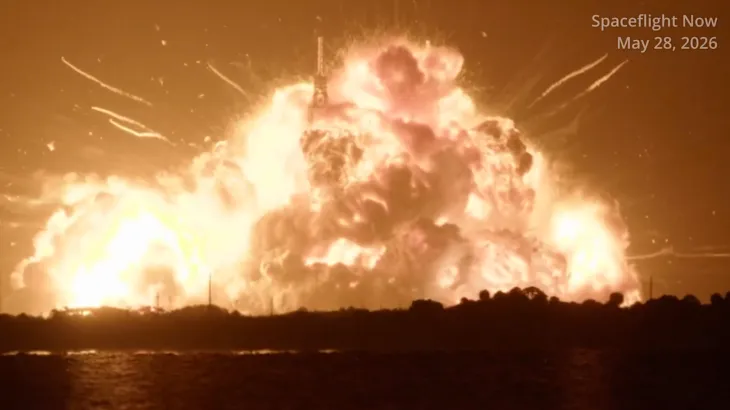
BREAKING: Jeff Bezos’ Blue Origin New Glenn Rocket Explodes on Cape Canaveral Launchpad During Static Fire Test

A massive fireball illuminated Florida’s Space Coast on the evening of Thursday, May 28, 2026, as Blue Origin’s flagship heavy-lift rocket, New Glenn, suffered a catastrophic structural failure and exploded. The incident occurred at approximately 9:00 PM Eastern Time at Space Launch Complex 36 (LC-36) at the Cape Canaveral Space Force Station.
The 321-foot-tall rocket was undergoing a routine, pre-flight static fire test when the entire vehicle erupted into a violent conflagration. The explosion shook nearby homes in Cape Canaveral and Cocoa Beach, turning the night sky a brilliant orange and triggering widespread alarm across social media.
Fortunately, Blue Origin confirmed that all personnel had evacuated the launchpad area prior to the test following standard safety protocols, and no injuries have been reported.


What Went Wrong? The Hotfire Test Anomaly
A static fire test is designed to stress-test a rocket’s propulsion systems. During the procedure, the heavy-lift booster’s seven methane-fueled BE-4 engines are ignited at full thrust while the vehicle remains bolted securely to the launchpad.
Seconds after engine ignition, an uncontrolled structural malfunction breached the first stage. Telemetry signals indicated a rapid tank failure, causing the methane fuel and liquid oxygen to mix and ignite into a massive, rolling explosion. As the first stage collapsed, the upper stage was consumed instantly by the flames.
The explosion completely destroyed the rocket and caused extensive damage to Launch Complex 36, including the destruction of the infrastructure.
Video Credit: Watcher.Guru – Instagram
Viral Social Media & Aerial Hookups
The dramatic explosion was caught from multiple angles, flooding video platforms as eyewitnesses and flight passengers shared their perspectives of the blast.
A Severe Blow to NASA’s Artemis and Moon Base Plans
This catastrophic explosion is being labeled a massive developmental setback. Just days prior to the incident, NASA had awarded Blue Origin a multi-million dollar contract to launch the initial payloads to begin building its $20 billion Moon Base.
Furthermore, New Glenn is slated to fly the company’s Blue Moon lunar lander, a direct competitor to SpaceX’s Starship for the upcoming Artemis III (2027) and Artemis IV (2028) crewed lunar missions. Space journalists noted that the absolute destruction of LC-36—Blue Origin’s primary operational New Glenn pad—will likely sideline the company from the Artemis lunar timeline for an extended period.
The disaster also compromises Amazon’s timeline, as this specific booster was scheduled to deploy a batch of “Project Kuiper” low-Earth orbit internet satellites on June 4, 2026. Fortunately, Amazon confirmed that no satellites were mounted on the rocket during the ground test.
Leadership Reactions: Bezos and Musk Respond
Despite the bleak outlook for the launch facility, Blue Origin founder Jeff Bezos struck an optimistic, albeit somber, tone on social media.
“It’s too early to know the root cause but we’re already working to find it. Very rough day, but we’ll rebuild whatever needs rebuilding and get back to flying. It’s worth it.”
— Jeff Bezos via X
NASA Administrator Jared Isaacman also weighed in, highlighting the volatile nature of the aerospace sector: “Spaceflight is unforgiving, and developing new heavy-lift launch capability is extraordinarily difficult. We will work with our partners to support a thorough investigation.“
Even billionaire rival Elon Musk, whose SpaceX vehicles dominate the heavy-lift market, offered words of solidarity, writing on X: “Most unfortunate.“
An official investigation involving the Federal Aviation Administration (FAA) is expected to commence immediately to discover the root engineering failure.
For real-time updates on the Cape Canaveral clean-up operations, investigation findings, and space flight schedules, bookmark this page.
External References & Sources: